
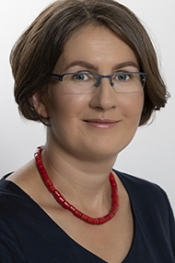
Dr. Magdalena Abraham-Diefenbach
SEK
Faculty of Social and Cultural Sciences
Professor of Monument StudiesAcademic Staff Member
Phone and office hours by appointment. Registration under: Abraham-Diefenbach@europa-uni.de
- Regional history and identity on the German-Polish border
- Media and propaganda history in the 20th century
- Jewish history in Poland and Germany with a focus on the Jewish cultural heritage in the Polish western territories
- Applied history
Monograph:
2016
Pałace i koszary. Kino w podzielonych miastach nad Odrą i Nysą Łużycką 1945–1989, Wrocław
Collection volumes:
2022
Zmarginalizowane dziedzictwo kulturowe i perspektywy rozwoju kultury regionalnej. Pałace, dwory i cmentarze żydowskie na pograniczu polsko-niemieckim (ed. together with Paul Zalewski), Frankfurt (Oder) / Słubice
2022
Marginalized cultural heritage and perspectives for regional cultural development. Schlösser, Gutshäuser und jüdische Friedhöfe im deutsch-polnischen Grenzland (ed. together with Paul Zalewski), Frankfurt (Oder) / Słubice
2012
Makom tov – the good place. Jüdischer Friedhof Frankfurt (Oder) / Słubice (ed. together with Eckard Reiß), Berlin
Article:
2023
Brandenburg östlich der Oder - geteilt und vergessen, in: Deutsches Kulturforum östliches Europa e.V. (ed.): Kulturkorrespondenz östliches Europa, No. 1435, pp. 5-7.
2022
Fleeing and Displacement in European Dialogue. Ideas for a German-Polish research, educational and cultural center on regional history in Frankfurt (Oder) / Ucieczka i wypędzenia w dialogu europejskim. Pomysły na polsko-niemieckie centrum badań, edukacji i kultury zajmujące się historią regionalną we Frankfurcie nad Odrą. Working Paper Series B/ORDERS IN MOTION No. 10, Frankfurt (Oder): doi.org/10.11584/b-orders.10
2021
Juden an der mittleren Oder. Transfer and Interdependence in the German-Polish Borderland from the Middle Ages to the 20th Century. State of research, source situation and applied projects (together with Rhena Stürmer), in: Studia Zachodnie, Zielona Góra, pp. 49-75.
2021
Freizeitorte, in: Kerstin Hinrichsen, Markus Nesselrodt (eds.) (2021): Stadführer Frankfurt (Oder) / Słubice, pp. 148-159.
Polish version: Spacer „Obiekty i tereny rekreacyjne“, w: Kerstin Hinrichsen, Markus Nesselrodt (eds.) (2021): Przewodnik po mieście. Frankfurt nad Odrą i Słubice, p. 148-159.
2021
Polska, niemiecka i żydowska pamięć o cmentarzach żydowskich w zachodniej Polsce, in: Joanna Lusek (ed.): Ślad pokoleń. Żydowskie dziedzictwo kulturowe w Polsce, Bytom 2021, pp. 183-202.
202020
Corona with a view to and across the Oder, in: Peter Ulrich, Norbert Cyrus, Anne Pilhofer (eds.) (2020): Borders and Orders in Motion in Times of the Corona Crisis. Analyses of region and society. Working Paper Series B/ORDERS IN MOTION No. 8, Frankfurt (Oder): Viadrina, doi:10.11584/B-ORDERS.8, pp: 8-11.
2020
Bellevue and Piast. Cinema in the divided cities on the German-Polish border 1945–1949. In: Wolfgang Flügel, Merve Lühr, Winfried Müller (eds.): Urbane Kinokultur. Das Lichtspieltheater in der Gro&sz;stadt 1896-1949, Dresden 2020, pp. 244-260.
2019
Post-Industrial Spaces in Saxony (Leipzig, Dresden), in: Aleksandra Kunce (Ed.): PostindustriaLab. Practicing a Post-Industrial Place, Gdańsk, pp. 47-64.
2018
Miejsca postindustrialne na terenie Saksonii (Lipsk, Drezno), in: Aleksandra Kunce (ed.): PostindustriaLab. Praktykowanie miejsca postindustrialnego, Gdańsk, pp. 53-71.
2017
Przeszłość i teraźniejszość terra transoderana. Historia Nowej Marchii jako historia transnarodowa. Past and present of the Terra Transoderana. The history of the Neumark as a transnational history of relations (together with Felix Ackermann). In: Andrzej Talarczuk, Edward Włodarczyk (ed.): Historyczna Nowa Marchia w histografii, kulturze, sztuce i architekturze − wczoraj, dzisiaj i jutro. Szczecin, 2017, pp. 154-167.
2015
Zwischen Mit- und Nebeneinander – Kinogeschichte als Archäologie des Alltags am der deutsch-polnischen Grenze 1945-1989, in: Brigitte Braun, Andrzej Dębski, Andrzej Gwóźdź (eds.): Unterwegs zum Nachbarn. German-Polish film encounters, Trier
2013
Applying history? On dealing with the past and history in Frankfurt (Oder) and Słubice (together with Juliane Tomann), in: Burkhard Olschowsky (ed.): Geteilte Regionen - geteilte Geschichtskulturen? Patterns of Identity Formation in European Comparison, Oldenburg, pp. 355-377.
2012
Angewandte Geschichte. Handeln im öffentlichen Spannungsfeld zwischen Wissenschaft, Zivilgesellschaft und Denkmalschutz (together with Felix Ackermann), in: Paul Zalewski, Joanna Drejer (eds.): Deutsch-polnisches Kulturerbe und die Zivilgesellschaft im heutigen Polen. Erfahrungen, Trends, Chancen, Warszawa, pp. 187-199.
2010
Article on Puck/Putzig, Słupsk/Stolp and Lębork/Lauenburg, in: Jüdische Spuren in der Kaschubei. A travel guide, edited by Miłosława Borzyszkowska-Szewczyk and Christian Pletzing, Meidenbauer Verlag, München. pp. 71-87 and 329-369.
2008
Flucht, Vertreibung, Aussiedlung. The eastern part of Brandenburg in 1945, in: Terra transoderana. Between Neumark and Ziemia Lubuska, beb.ra, Berlin, pp. 39-47.
Reviews:
2022
Peter Bahl, Burden and enrichment. Vertriebenenintegration in Brandenburg ab 1945. in: Zeitschrift für Ostmitteleuropa-Forschung (Journal of East Central European Studies) Vol. 71, No. 4/2022, pp. 685-687 and in: sehepunkte 23 (2023), No. 2 (15.02.2023)
2021
„Man bleibt eben immer der Flüchtling.“ Eine Quellenedition zur Flucht und Vertreibung aus dem Kreis Arnswalde 1945–1947. Veronika Kölling (ed.) and Klaus Neitmann (ed.) (Publications of the Brandenburg State Archives, vol. 33). Berlin: Berliner Wissenschafts-Verlag, 2020. XVII, 289, [30] p., 51 ill. – ISBN 978-3-8305-5009-9 (60,00 Euro), in: Jahrbuch für die Geschichte Mittel- und Ostdeutschlands, vol. 66, no. 1, 2021, pp. 434-438.
2017
Review for: Lars Breuer (2015), Communicative Memory in Germany and Poland. Images of perpetrators and victims in conversations about the Second World War.
2014
Review for: Beata Halicka (2013): Poland's Wild West. Forced Migration and the Cultural Appropriation of the Oder Region in 1945 – 1948
Published translations from German:
- Wilhelm Reich: Psychologia mas wobec faszyzmu (Mass Psychology of Fascism). Aletheia, Warszawa 2009 (together with Ewa Drzazgowska)
- Friedrich Schiller: Kallias, czyli o pięknie (Kallias or about beauty). Antyk, Kęty 2007 (as part of a working group at the Nicolaus Copernicus University in Toruń)
- Immanuel Kant: Jedyna możliwa podstawa dowodu na istnienie Boga (The only possible reason for a demonstration of the existence of God). Antyk, Kęty 2004 (as part of a working group at the Nicolaus Copernicus University in Toruń)
09/2017 – 01/2019
Working on the concept for the Brandenburg Foundation „Brandenburg östlich der Oder – Erinnerung bewahren – Europa stärken. Structural and development concept for the new institution for the history of historical East Brandenburg (today parts of the voivodeships of Lubusz and West Pomerania in Poland) in the Collegienhaus in Frankfurt (Oder).
Since 05/2017
Scientific assistant at the Chair of Monument Studies at the European University Viadrina (50% post-doc position)
2016 – 2017
Curator of the German-Polish exhibition „In the Flow of Time. Jüdisches Leben an der Oder“ (together with Magdalena Gebala for the German Cultural Forum östliches Europa)
Since 2017
Scientific assistant at the Chair of Monument Studies at the European University Viadrina.
2016–2017
Academic assistant at the European University Viadrina in Frankfurt (Oder), in the project "Wandering Borders – Wandering People" at the German-Polish Research Institute.
2014–2015
Research associate at the European University Viadrina in Frankfurt (Oder), coordination of a seed money project: „The Community of the Borderland? On problems of identification with the region by Polish and German inhabitants of the Oder region after 1945“ at the German-Polish Research Institute.
2010–2015
PhD at the Willy Brandt Center for German and European Studies at the University of Wrocław as part of the research project: „Polish and German Cinema on the Border of Cultures“, supervisor: Prof. Dr. Andrzej Gwóźdź, Silesian University in Katowice, topic of the dissertation: „Cinema on the German-Polish Border 1945–1989: Neighborhood and Propaganda“.
Since 2010
Professional work as a translator, interpreter and project coordinator.
2000–2004
Studied German as a foreign language at the Foreign Language Teaching College, Toruń and at the Silesian University, Katowice.
1998–2006
Master's degree in Philosophy at the Nicolaus Copernicus University in Toruń, specializing in 19th and 20th century German philosophy, translation of philosophical texts by Kant, Schiller, Kierkegaard, master's thesis on the concept of freedom in Arthur Schopenhauer.
1998–2005
Master's degree in sociology at the Nicolaus Copernicus University in Toruń, specializing in: Civil society and its forms of organization, master's thesis on volunteer services – a comparison between Italy and Poland.
Further education:
2010
Qualification as an EU fundraiser, emcra – Europa aktiv nutzen, Berlin
2009–2010
Training as a mediator, mediation center in the border region Frankfurt (Oder) / Słubice e.V.
Summer semester 2019:
Musealization of the memory of homeland after the border shifts in 20th century Europe
Summer semester 2020:
Synagogues and cemeteries. Jewish cultural heritage in western Poland from 1945 to the present day
Summer semester 2021:
German expellees – From revisionists to cultural heritage activists? The case: (East) Brandenburg
Memberships:
- Insitut für angewandte Geschichte - Gesellschaft und Wissenschaft im Dialog e.V.
- Brandenburg Historical Commission e.V.
- Commission for the History of Germans in Poland
- Advisory board of the museum or spree
Third-party funded projects:
- The sea Pomerania the border region as places of German-Polish dialog
- Jews in historic East Brandenburg – an online documentation of Jewish cemeteries
Contact
Collegium Polonicum (CP)ul. Kościuszki 1
69-100 Słubice
- CP 113
+49 335 5534 6772 +49 335 5534 16 6772 abraham-diefenbach@europa-uni.de