


European and International Politics - Prof. Dr Jürgen Neyer

Professorship for European and International Politics

Welcome!

We work on various issues of European and international politics. Current research projects examine the conditions of European integration and inter-state co-operation as well as the possibility of cross-border dialogue. This includes the dynamics of European narratives and their impact on European sovereignty, the integration of civil society actors in international organisations and the analysis of the motives of female fighters in Kurdistan. The Chair collaborates with Bauhaus-Universität Weimar to develop AI-based tools for research and teaching.


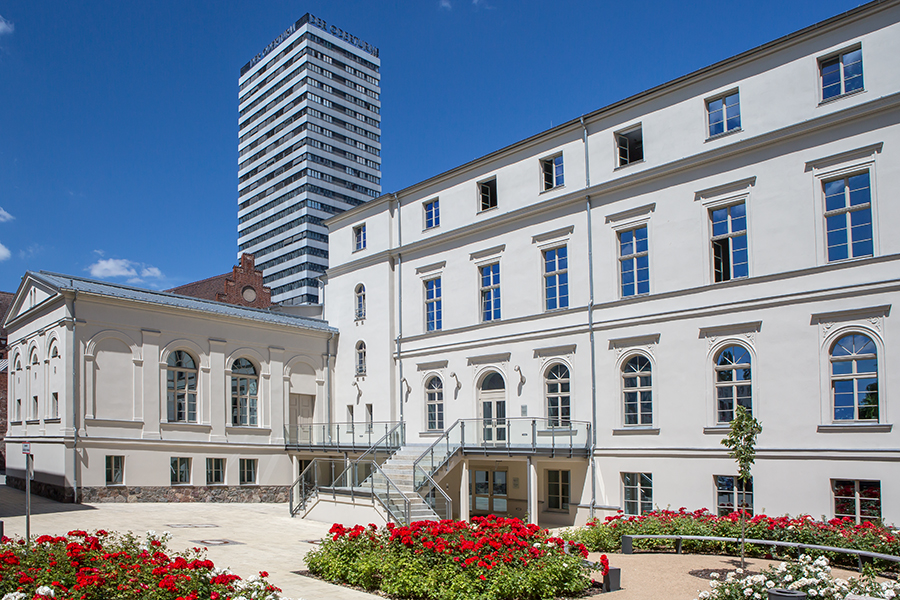
Logenhaus south side

Current research

  • examines the causes and effects of narratives in European and international politics
  • develops LLM-based methods for tracing narratives in large text corpora (together with Benno Stein and Matti Wiegmann of the Bauhaus University Weimar)
  • works with a large text corpus of verbatim records of the European Parliament covering all plenary speeches until 1996. It can be retrieved here.
  • is interested in MA and PhD projects developing narrative theory and applying it empirically, working with the EP text corpus and using innovative LLM-based research techniques

Chair

Jürgen Neyer holds the Chair of European and International Politics at the European University Viadrina Frankfurt (Oder). Previously, he held positions in research and teaching at the Johann-Wolfgang-Goethe University in Frankfurt am Main, the University of Bremen, the Max Planck Institute for Research on Collective Goods in Bonn, the European University Institute in Florence and the University of Berkeley in California. He was also a visiting professor at the Universities of Haifa and Jerusalem, Israel, and Ottawa, Canada. He has been awarded a Humboldt Fellowship from the DFG and an Opus Magnum Fellowship from the Volkswagen Foundation.

Jürgen Neyer was the Founding Director of the European New School of Digital Studies, Vice President of the European University Viadrina and Dean of the Faculty of Social and Cultural Sciences at the European University Viadrina. His current research focus is on the use of LLMs for tracing arguments and narratives in large text corpora.

Neyer's most recent book is "Europa im Unfrieden. Soziale Konflikte und politische Umwälzungen in der europäischen Geschichte und Gegenwart" published by transcript.

A recent article summarising the central argument of the book can be found here.

To schedule an appointment with Prof Neyer, please use this online calendar.

neyer-juergen

Latest news

Wiegmann, Matti/ Neyer, Jürgen/ Stein, Benno (2026): Detecting Foundational Narratives in Parliament Speeches

Narratives are a common tool for expressing and consolidating the identity and beliefs of mgroups of people. In politics, foundational narratives describe deeply held beliefs about power and collective identity which political actors often use tacitly to convince supporters and consolidate power. Although these narratives are highly relevant to understand political discourse, their algorithmic detection and quantification is a new venture in NLP research, as it requires knowledge of, and competent reasoning about, political discourse. In this paper, we formulate the task of foundational narrative detection as a one-class classification problem. We present a new dataset comprising English speeches from the European Parliament that have been annotated by expert political scientists. We also propose an effective classification approach, evaluating the impact of model selection, task formulation and explicit knowledge on classification accuracy. However, due to the complexity of the task and the influence of biases and subjectivity, we do not consider direct classification, whether by human or LLM, to be the ultimate solution for labelling political texts according to narratives. As an alternative, we present two prompt strategies with comparable performance that classify political texts indirectly by reasoning over generated pro and con arguments.

Read more


Wiegmann, Matti/ Neyer, Jürgen/ Stein, Benno (2026): Exploring Two Decades of Parliamentary Speeches on the Use of Narratives

Political scientists are interested in changes in political discourse over time. However, the topics of interest, such as the changes in support for or understanding of certain narratives, are often ill-defined and require deliberation, which prevents most lexical or metadata-based methods of temporal aggregation. To enable a diachronic analysis, we propose to model such settings as a series of binary document classification tasks – which current reasoning LLMs can adequately solve – and aggregate the decisions into a temporal signal. Specifically, we propose to use LLMs to classify if a parliament speech is in support of either of two narratives, and we use the monthly count of positives per narrative to track the support over time. We show that the classification is sufficiently accurate and use it to create detailed time series data showing support for the selected narratives in speeches given in the European Parliament from 2006 to 2023. The method is developed in close collaboration with political scientists and is considered an ideal starting point for diachronic analyses of political decision-making processes by domain experts.

Read more

Wolska, Magdalena/ Wiegmann, Matti/ Gholiagha, Sassan/ Sienknecht, Mitja (2026): "SKILL-IR-Discourse: A Large, Annotated Corpus of Argumentation and Domain Discourse on International Relations"

We present a large annotated corpus of scholarly discourse in the domain of International Relations, a subfield of political science. The corpus comprises 190 articles (over 1500K tokens) annotated at the argumentation, basic rhetorical, and domain level. Five of the included articles (ca. 62K tokens) constitute a Gold-standard, coded by domain experts. The remaining articles were coded by annotators trained on the Gold-standard and monitored for annotation quality. We describe our corpus creation methodology, the annotation process and quality assurance, the corpus itself, and present insights into the data: Most argumentative structures in the data are simple premise-conclusion structures, fewer than half of the claims have explicit supporting evidence. Counter-arguments to claims are rare. The claim-to-support ratio varies widely between articles; possibly to some extent due to the topics covered (with clear common ground) or to the differences between authors’ styles. The distribution of theoretical vs. evaluative statements varies strongly between articles; this can be attributed to such factors as different methodological approaches between the articles and the methodological focus of the publishing journal.

Read more

Team

Here you can find out more about the team of the professorship.

Read more

Research and teaching

Studierende in der UB

Research

Overview of the research projects at the Chair of European and International Politics

Read more
Student sitzt am Laptop im Vorlesungssaal

Study and teaching

Current courses and general information on studying and assignments at the chair

Read more
die Bücher, Nahaufnahme

Publications

Here you will find an overview of our team's publications.

Read more