
Welcome to the department of Language and Media Studies!
About us
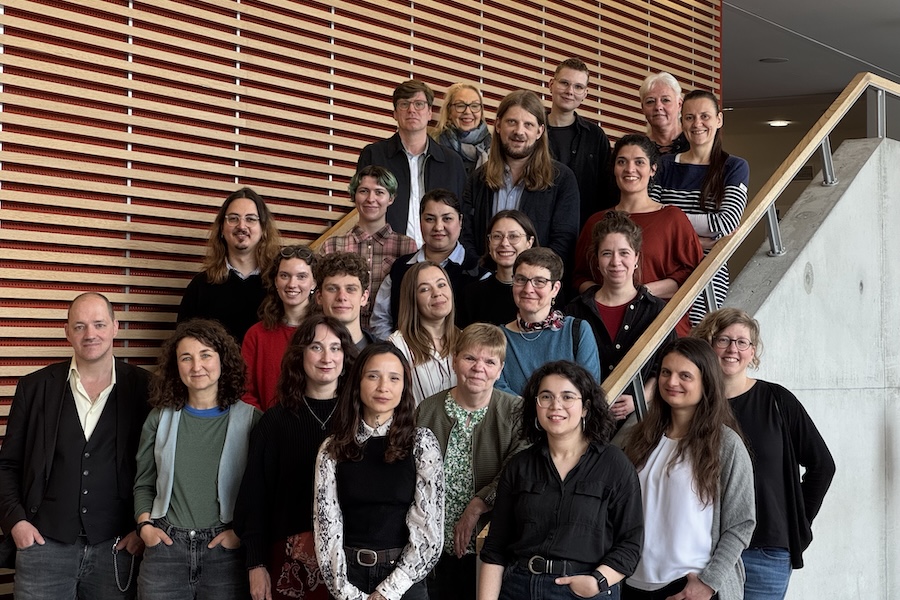
Department Language and Media Studies
Andrea Ruhland
About the department
In the department we research language and media as social and cultural forms in their concrete media and social environments. We ask how cultural transformations change language and media and, conversely, how language and media produce forms of feeling, perception, thinking and community formation. We investigate how linguistic and media practices produce concepts of history and society, and how this connects with processes of community building and feelings of belonging.
Our focus is on the precise analysis of linguistic and media forms of expression and formats and covers a broad range of topics and phenomena including:
Connections between language, culture and society in discourse and interaction, especially in the context of technology, mediality and digitality. Here we deal with questions about the role of language and communication in the digital transformation of society, how language and communication change in the course of digitality and mediatisation.
Relationships between language, society, migration, and technology, in particular how digital cultures (re)shape linguistic norms and community definitions. We explore how multilingualism influences identity and social dynamics, critically analyse media representations and the role of language in social inclusion and exclusion practices.
The entanglement of the multimodality of speech with the multimodality of audiovisual media. We bring together linguistic and media-aesthetic approaches to analyse language, gesture and audiovisual images. We are interested in understanding the dynamics of meaning-making, its grounding in embodied experience, the interaffectivity of multimodal communication and
Popular cultural phenomena, such as movies, television series and video games. We assume that their close analysis can help us to understand the longings and fears, hopes, dreams and needs of communities of viewers and players of video games. In this sense, popular culture research can serve as an instrument for analysing culture and diagnosing the times and contribute to sharpening our view of a present that, marked by global crises and conflicts, inspires apocalyptic doomsday scenarios as well as transhumanist visions of the future and ecocritical utopias.
Department of Language and Media Studies
Secretary Office
Iris Franke
Auditorium maximum (AM)
Logenstraße 4
Mailing Adress
Europa-Universität Viadrina
Fakultät für Kulturwissenschaften
Große Scharrnstr. 59
15230 Frankfurt (Oder)
News
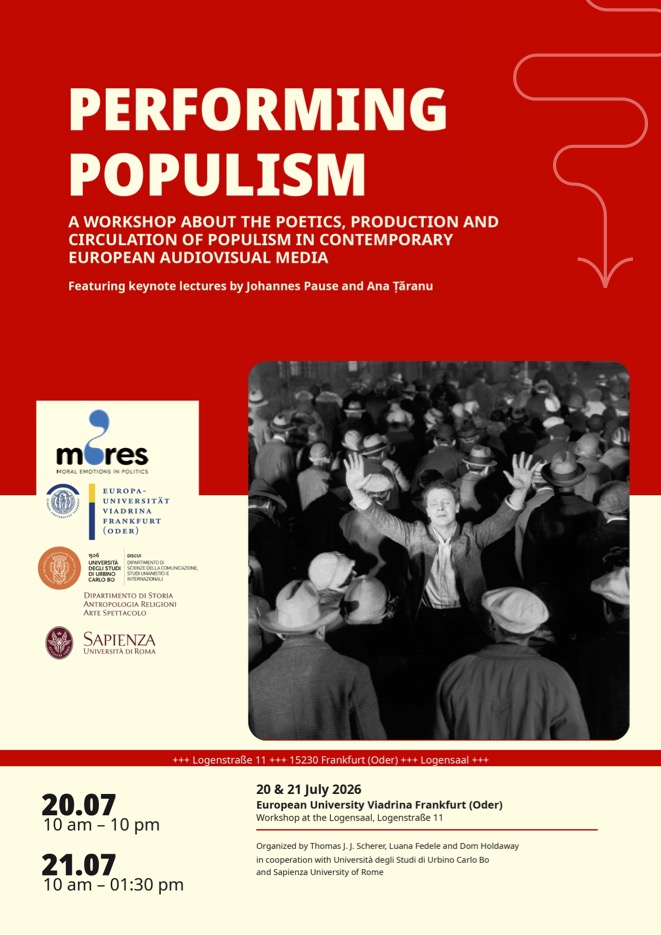
Thomas Scherer
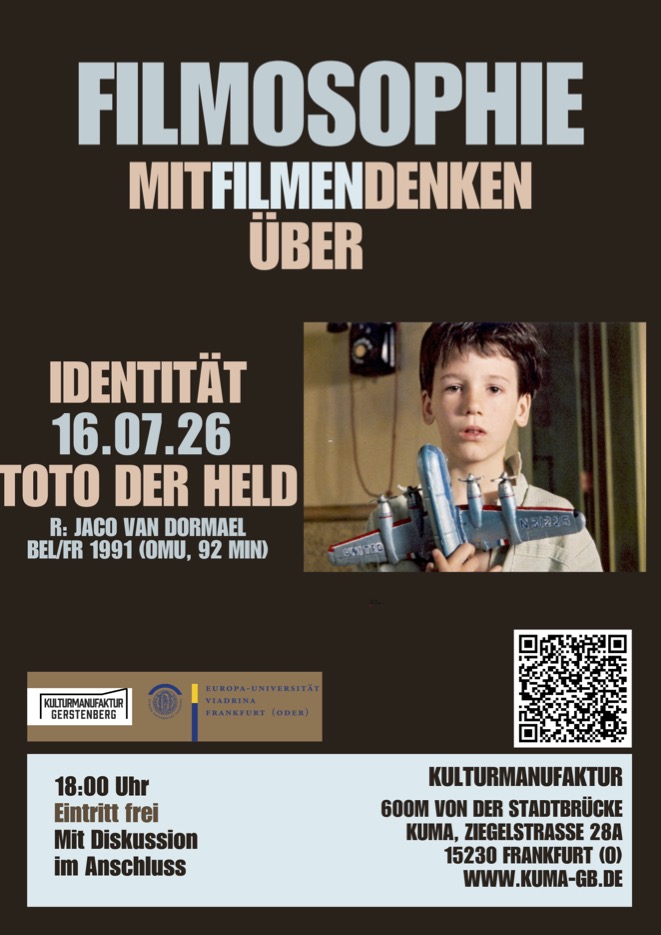
Department
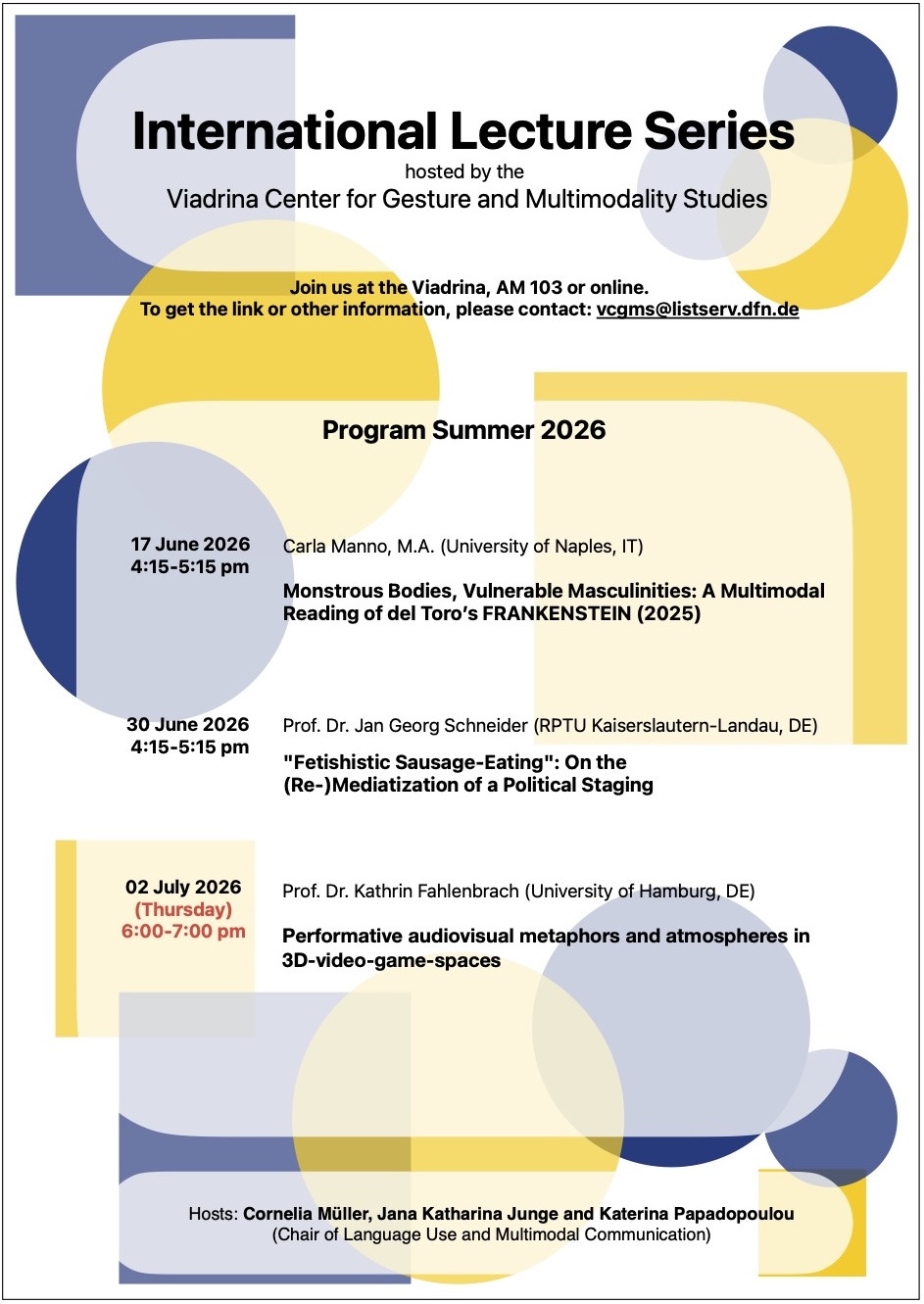
Katerina Papadopoulou / Jana Katharina Junge
Study with us
Language and Media Studies (M.A.)
How do language and media influence public discourse, social groups and power structures in society? What makes TikTok videos so mesmerising? How do AI algorithms shape our communication? In today’s world, media is a dominant force: We navigate digital spaces, use audiovisual media extensively, and engage in social and linguistic exchanges – often without considering how media and language shape and transform us and our societies.
The Master’s degree programme in Language and Media Studies equips you with the academic knowledge and practical skills necessary to understand the mechanisms, functions and effects of language and media. It integrates methodological, theoretical and empirical approaches of film and media studies as well as culturally oriented research on language use.
Multimodality - Discourse - Media (M.A.)
As part of the Master’s programme in Language and Media Studies, you can also pursue the international double degree in “Multimodality – Discourse – Media” through a collaboration with the Université Sorbonne Nouvelle – Paris 3.
Discover MuDiM! Do you want to understand how gestures, language, and digital media come together in the ways we communicate? Or how videos, films and social media work? And what their effects are? Then enrol on the Master's degree programme "Multimodality - Discourse - Media" with its focus on understanding and analysing discourse from the perspective of linguistic and media studies and multimodality research. You will study in Paris and in Frankfurt (Oder), just one hour outside Berlin. The European University Viadrina in Frankfurt (Oder) offers an international environment with students from over 100 countries and the Sorbonne Nouvelle is located in the centre of Paris. Students who complete the MuDiM course will receive a Master's degree in France and in Germany. This degree programme is sponsored by the Franco-German University (DFH).
Recent seminars
Modules within study programs
Within the bachelor and master programs of the Faculty of Social and Cultural Sciences, the Department of Language and Media Studies offers various modules that you can choose from.
Kulturwissenschaften: Vertiefung
- Somebody is watching. Audiovisuelle Poetiken der Überwachung (Lucia Wiedergrün)
- Analysing Social Media Clips - A Crash Course (Katerina Papadopoulou)
- Medientheorie (Jana Junge)
- Courtroom trials: How we judge through metaphors (Katerina Papadopoulou)
- Discourse, identity and representation (Vinicio Ntouvlis)
- From Road Signs to Graffiti: Exploring Linguistic Landscapes and Minorities (Karolin Breda)
Linguistik: Einführung
- Einführung in die Linguistik (Miriam Lind)
- Sprachtheorie und Sprachgeschichte (Rita Vallentin)
Linguistik: Vertiefung
- Big Data meets Culture - kulturwissenschaftliche Korpuslinguistik (Miriam Lind)
- "Runter von der Autobahn": Text-Bild-Kompositionen in öffentlichen Diskursen über das Lebensende (Sarah Schön)
- Analysing Social Media Clips - A Crash Course (Katerina Papadopoulou)
- Digital Discourse Analysis (Kateryna Pilyarchuk)
- Media, Discourse, and Feminism (Kateryna Pilyarchuk)
- Language Diversity (Rita Vallentin)
- How Children Learn to Speak: On Language Acquisition Studies (Nicole Richter)
- Sociolinguistic Approaches to AI Technologies (Didem Leblebici)
- From Road Signs to Graffiti: Exploring Linguistic Landscapes and Minorities (Karolin Breda)
- Courtroom trials: How we judge through metaphors (Katerina Papadopoulou)
Praxisrelevante Fertigkeiten
- Academic Reading and Knowledge Organization (Jana Junge)
- Academic Writing with AI: Applying the New Guidelines in Practice (Didem Leblebici)
Cultural and Social Studies: Consolidation
- Sociolinguistic Approaches to AI Technologies (Didem Leblebici)
- How Children Learn to Speak: On Language Acquisition Studies (Nicole Richter)
- Analysing Social Media Clips - A Crash Course (Katerina Papadopoulou)
Media – Image, Text and Language
- Somebody is watching. Audiovisuelle Poetiken der Überwachung (Lucia Wiedergrün)
- Empirical research in multilingualism (Galyna Orlova)
- Courtroom trials: How we judge through metaphors (Katerina Papadopoulou)
- Analysing Social Media Clips - A Crash Course (Katerina Papadopoulou)
- Medientheorie (Jana Junge)
- From Road Signs to Graffiti: Exploring Linguistic Landscapes and Minorities (Karolin Breda)
- Digital Discourse Analysis (Kateryna Pilyarchuk)
- Media, Discourse, and Feminism (Kateryna Pilyarchuk)
- Big Data meets Culture - kulturwissenschaftliche Korpuslinguistik (Miriam Lind)
- "Runter von der Autobahn": Text-Bild-Kompositionen in öffentlichen Diskursen über das Lebensende (Sarah Schön)
Difference – Migration, Gender and Diversity
- Discourse, identity and representation (Vinicio Ntouvlis)
- Words We Wear: Language, Identity, and Fashion (Kateryna Pilyarchuk)
- Media, Discourse, and Feminism (Kateryna Pilyarchuk)
- Language Diversity (Rita Vallentin)
Methods, Academic Writing and Research Skills
- Forschungskolloquium Sprache - Menschen - Medien (Miriam Lind)
- Kolloquium Language in Society (Rita Vallentin)
Practical Skills
- Academic Writing with AI: Applying the New Guidelines in Practice (Didem Leblebici)
- Academic Reading and Knowledge Organization (Jana Junge)
Migration, Öffentlichkeit und Medien
- Media, Discourse, and Feminism (Kateryna Pilyarchuk)
- Courtroom trials: How we judge through metaphors (Katerina Papadopoulou)
Modul III.4.: Recht und Politik im transnationalen Kontext (Vertiefung)
- Media, Discourse, and Feminism (Kateryna Pilyarchuk)
- Courtroom trials: How we judge through metaphors (Katerina Papadopoulou)
Praxisrelevante Fertigkeiten
- Academic Reading and Knowledge Organization (Jana Junge)
- Academic Writing with AI: Applying the New Guidelines in Practice (Didem Leblebici)
Zentralmodul: Theoretische und methodische Grundlagen
- Interaktion und Verkörperung: Klassische und aktuelle Ansätze der Interaktionsforschung (Cornelia Müller)
- Platforms and power: Critical discourse approaches to social media (Vinicio Ntouvlis)
Wahlpflichtmodul: Mehrsprachigkeit und Interaktion
- Die Wirkung mündlicher Sprache: face-to-face und medial vermittelt (Nicole Richter)
- Language, Agency and Machines: Contemporary Readings in Discourse, Interaction and Anthropomorphism (Rita Vallentin)
- People, Pets, and ChatGPT: Human-nonhuman communication (Miriam Lind)
Wahlpflichtmodul: Multimodalität, Diskurs und Medien
- Performing Power: Gestures in Politics (Cornelia Müller)
- The Future after the Future – The Aesthetics of Eastern European Ruin Cinema (Thomas Scherer)
- Authentizität und/oder Inszenierung? Körpergesten im internationalen Fußball (Cornelia Müller)
Wahlpflichtmodul: Intercultural Communication
- People, Pets, and ChatGPT: Human-nonhuman communication (Miriam Lind)
- Authentizität und/oder Inszenierung? Körpergesten im internationalen Fußball (Cornelia Müller)
Forschungsmodul
- Forschungskolloquium Sprache - Menschen - Medien (Miriam Lind)
- Forschungsseminar "Sprachgebrauch und Multimodale Kommunikation" (Cornelia Müller)
- Kolloquium Language in Society (Rita Vallentin)
Praxisrelevante Fertigkeiten
- Academic Reading and Knowledge Organization (Jana Junge)
- Academic Writing with AI: Applying the New Guidelines in Practice (Didem Leblebici)
Wahlpflichtmodul: Wissenskulturen und Künste
Praxisrelevante Fertigkeiten
- Academic Reading and Knowledge Organization (Jana Junge)
- Academic Writing with AI: Applying the New Guidelines in Practice (Didem Leblebici)
Praxisrelevante Fertigkeiten
- Academic Reading and Knowledge Organization (Jana Junge)
- Academic Writing with AI: Applying the New Guidelines in Practice (Didem Leblebici
Wahlpflichtmodul: Kulturelle Praktiken, Wissensordnungen, ästhetische Formationen
Praxisrelevante Fertigkeiten
- Academic Writing with AI: Applying the New Guidelines in Practice (Didem Leblebici)
- Academic Reading and Knowledge Organization (Jana Junge)
Guidelines for students
Brief guide to writing seminar papers
Kurze Handreichung zum Schreiben von Hausarbeiten
Regulations on the use of AI tools
>>> More information on organisation of studies (regulations, guidelines, module plans)
B.A. and M.A. theses of our graduates
“It was never about what the German people actually need”—Audiovisual and Verbal-Gestural Storytelling: A Case Study of Right-Wing Extremism on TikTok
(Paul Jonas Kern, Multimodaly - Discourse - Media (M.A.), winter semester 2024/2025, supervising profesor: Prof. Dr. Cornelia Müller)
„Hasi, Schnucki, Mausebär“ – Über die Verwendung von Kosenamen in romantischen Beziehungen
(Nora Gail, Master Study program, summer semester 2024, supervising profesor: Prof. Dr. Britta Schneider)
„Zur Rhetorik von medial vermittelten feierlichen Ansprachen: eine sprachwissenschaftliche Studie zu den Neujahrsansprachen 2022 von Präsident Wolodymyr Selenskyj und Bundeskanzler Olaf Scholz“
(Mariia Shykova, Sprache – Medien – Gesellschaft (M.A.), summer term 2024, supervising profesor: Prof. Dr. Nicole Richter)
Current research topics
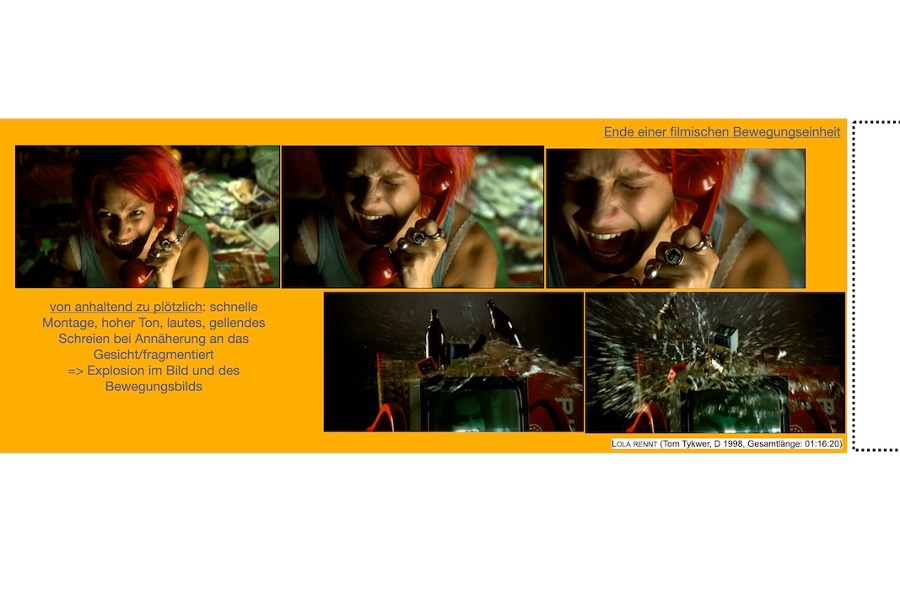
- affectivity and perception in film and audiovisual images
- embodied meaning and cinematic metaphor
- rhythm, tempo and kinaesthetics of audiovisual images and of embedded voices, gestures and facial expressions
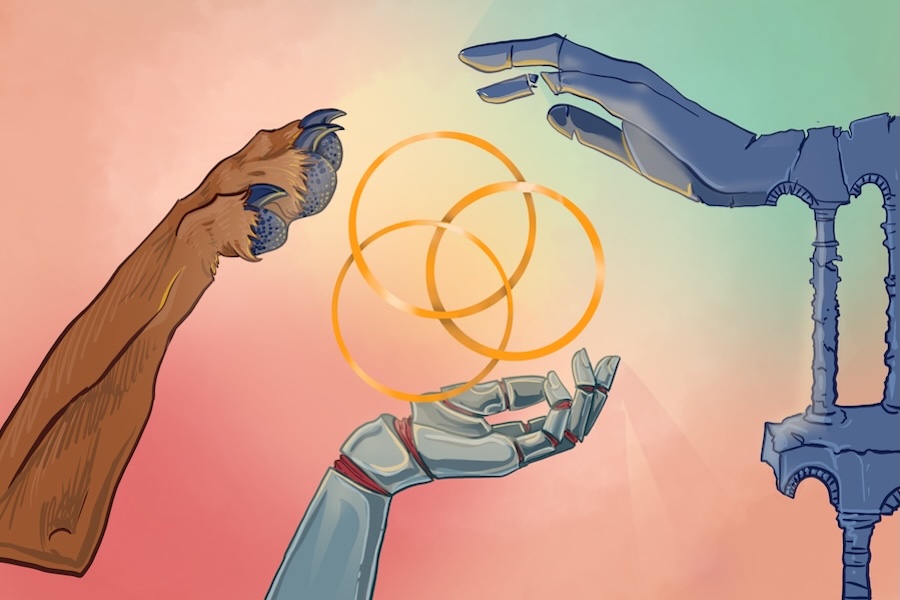
- Cultural Fantasies of AI
- The Eschaton in Popular Culture
- “Fernweh” and the Fantastic
- Theory and Poetics of Adventure
- The Phenomenology of Scars
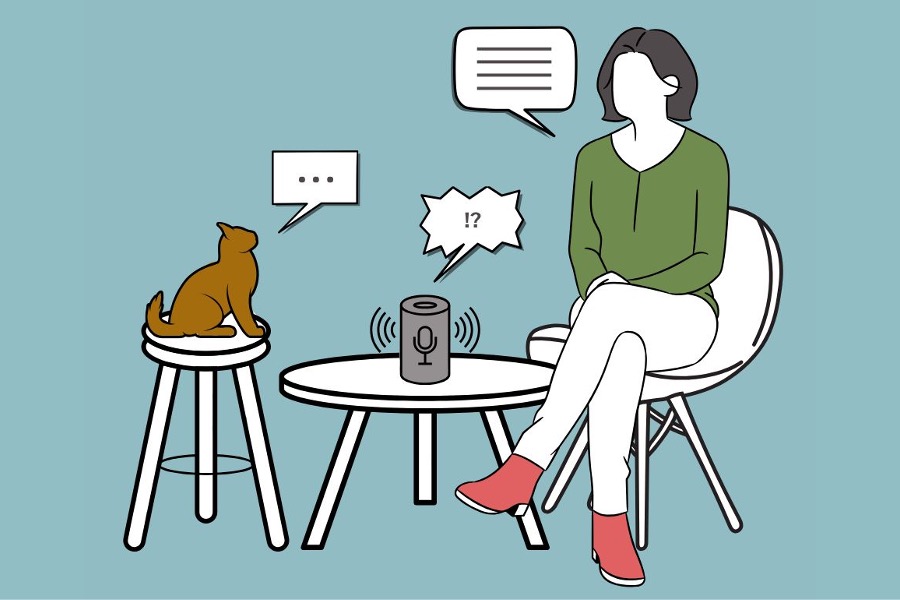
- Communicative practices between humans, animals, and machines
- Posthumanist approaches to language
- Human-machine interaction
- Human-animal interaction
- Communication technology for pets
- Multimodality of speaking and audiovisual multimodality
- Gesture and language
- Multimodal stancetaking and affectivity in parliamentary debates
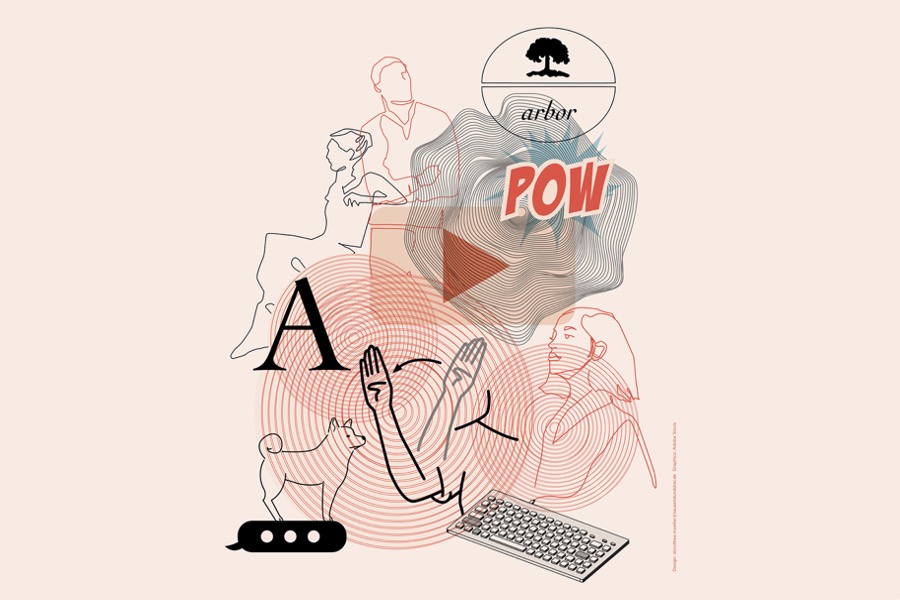
- Language ideology research
- Multilingualism
- Language and globalisation
- Language and AI
- Language and digitalisation
- Post-nationalism
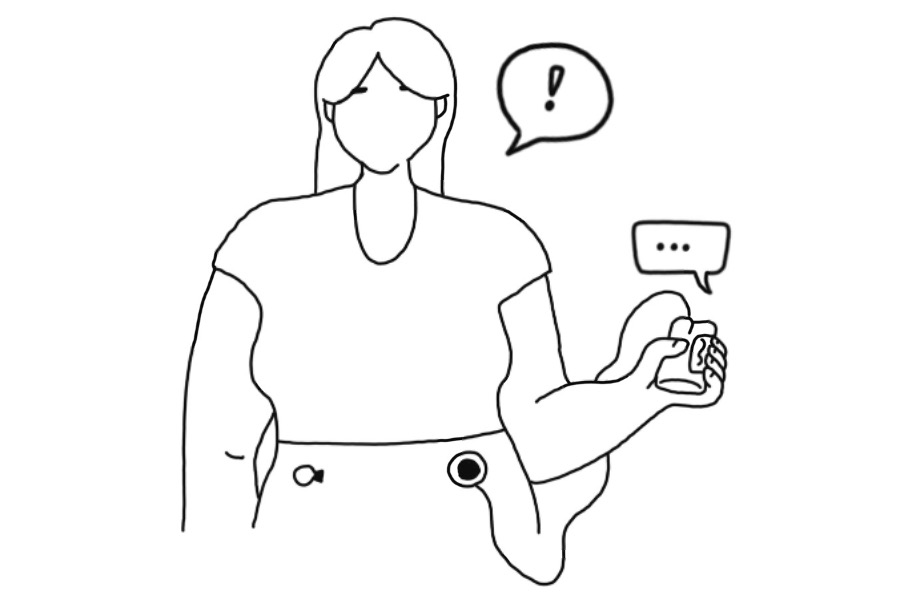
- Discursive Constructions of Human-Machine-Relations
- Language and Belonging
- Human-Machine-Interaction
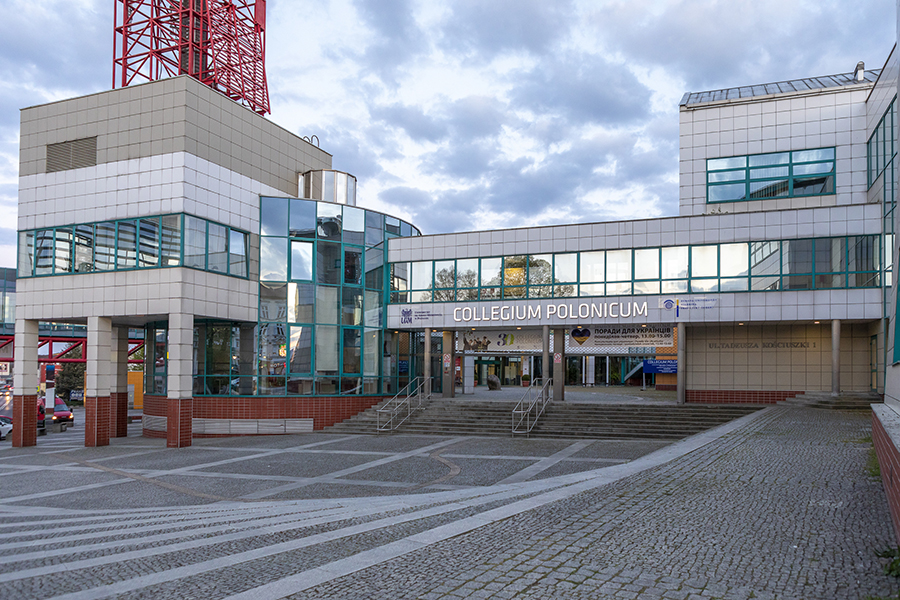
- Oral communication
- Slavonic languages
- Multilingualism in borderlands
- Spontaneous speech
- Rhetorics
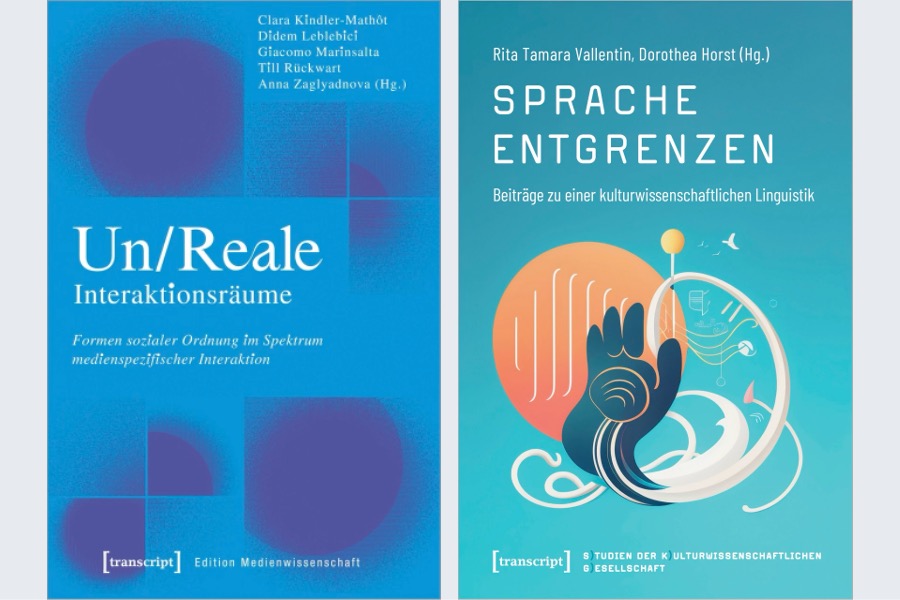
The research carried out by our department is reflected in our current publications. The following document provides an overview of the publications by members of the Department of Language and Media Studies from the current year.
Members of the department
Professors
Acting Professors
Associated members
Senior Scholars / Emeriti
Administration and Secretaries
Student assistants
- Kachel, Zora
- Metzkow, Frieda
- Nguyen, Jenny
- Löwisch, Carlynn
- Shipley, Julie
- Shpanova, Arina
- Wittschorek, Nikolai
PhD students and Postdocs
- Bauer, Jeanette-Christine
- Bonin, Sara
- Breda, Karolin
- Godiva, Stephanie
- Jacobshagen, Marlén
- Junge, Jana Katharina
- Kindler-Mathôt, Clara
- Kraus, Dorothée (vorher: Schulz-Budick), (Dr.)
- Leblebici, Didem
- Louzada, Bruna
- Meer, Somaiya
- Müller, Patrick
- Mykhalonok, Mariia
- Neumann, Elizabeth
- Ntouvlis, Vinicio (Dr.)
- Orlova-Malhofer, Galyna
- Otlewska-Dräger, Dominika
- Papadopoulou, Katerina
- Pappalardo, David
- Pilyarchuk, Kateryna
- Rostom, May
- Sawall, Hannah
- Schön, Sarah
- Weidauer, Sebastian
- Wiedergrün, Lucia
In Media
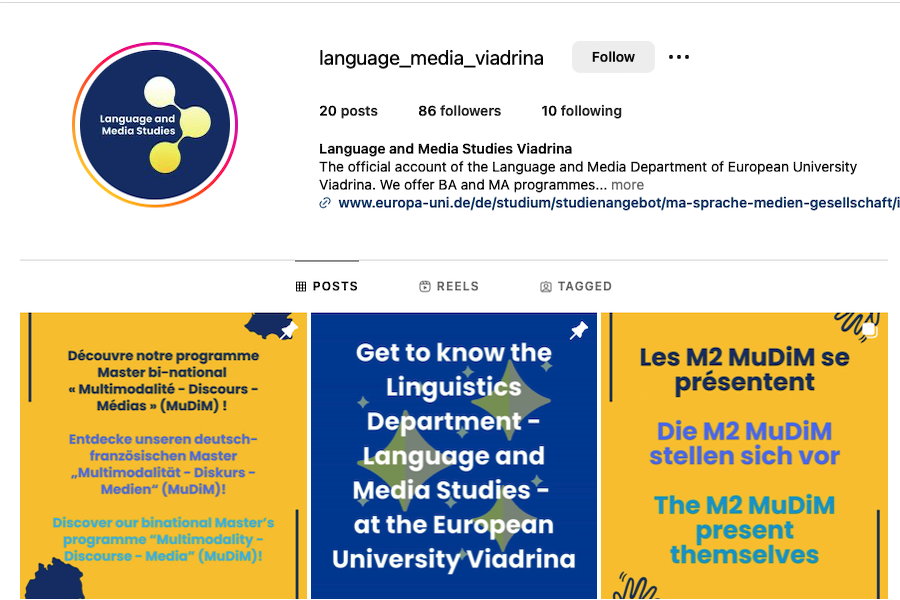
Follow us on Instagram!
The official account of the Department of Language and Media Studies of the European University Viadrina.
Follow us on YouTube!
Listen to podcasts by students and tune into recorded lectures on our department YouTube account.